Updated August 2026
How much insulation does a Delaware home need? If you’ve ever tried to figure that out, you may have seen recommendations ranging from R-30 to R-60. Both are possible, depending on which part of the house you’re insulating and whether it’s a new build or an existing home.
Heating and cooling account for nearly half of a typical home’s yearly energy costs. If your insulation isn’t up to the recommended R-value in Delaware, it can affect your comfort and raise your energy bills throughout the year.
Here’s what you need to know: The 2018 IECC Delaware energy code requires new homes in Delaware Climate Zone 4A to have R-49 attic insulation, R-20 for wood-frame walls, or R-13 cavity insulation plus R-5 continuous insulation, R-19 for floors, and either R-10 continuous or R-13 cavity insulation for basement and crawl space walls. In some areas, existing homes may benefit from slightly higher insulation levels.
These numbers are a good starting point. A no-pressure home insulation evaluation can show you where your home meets the targets and where it might need improvements.
Delaware Is Climate Zone 4A—and That Sets Every Target
The Climate Zone
New Castle, Kent, and Sussex counties are all in Delaware Climate Zone 4A, which is considered mixed-humid. Insulation in this zone needs to handle both heating and cooling year-round, as well as the moisture that comes with Delaware’s climate.
Insulation slows down heat loss in winter and helps keep heat and humidity out in summer. It’s important all year, not just in colder months.
The Code
Delaware’s residential energy code follows Delaware’s 2018 IECC, which DNREC adopted statewide on December 11, 2020. Table R402.1.2 sets the minimum insulation levels for Delaware homes built under this code.
R-Value in One Sentence
R-value shows how well insulation resists heat flow. A higher number means better insulation.
Recommended R-Values for Delaware Homes
2018 IECC Zone 4 Minimums
The following targets are the minimum requirements for new construction in Delaware Climate Zone 4A:
Existing-Home Retrofit Guidance
These code requirements are for new construction. For existing homes in this region, recommendations are R-49 to R-60 for attics, R-13 to R-21 for exterior walls, and R-25 to R-30 for floors.
That’s why the recommended R-value in Delaware for existing homes may be higher than the minimum required by the state code.
| Home area | Target R-Value |
|---|---|
| Attic or ceiling | R-49 |
| Wood-frame walls | R-20 or R-13 cavity plus R-5 continuous |
| Floors over unconditioned space | R-19 |
| Basement walls | R-10 continuous or R-13 cavity |
| Crawl space walls | R-10 continuous or R-13 cavity |
| Slab edge | R-10 to a depth of 2 feet |
Where to Start
The attic is usually the best place to start. Since heat rises, an attic without enough insulation is often a major source of heat loss. Checking your attic insulation R-value in Delaware is a practical first step.
For new homes, R-49 attic insulation is the minimum required by code. Existing homes may need R-49 to R-60, depending on what’s already there. Professional attic insulation services can determine if you need more insulation.
Material Choice
Fiberglass, cellulose, and other materials need different depths to reach the same R-value. This guide to choosing the right insulation for your Delaware home explains the differences in more detail.
How to Tell Whether Your Home Measures Up
The Attic Depth Check
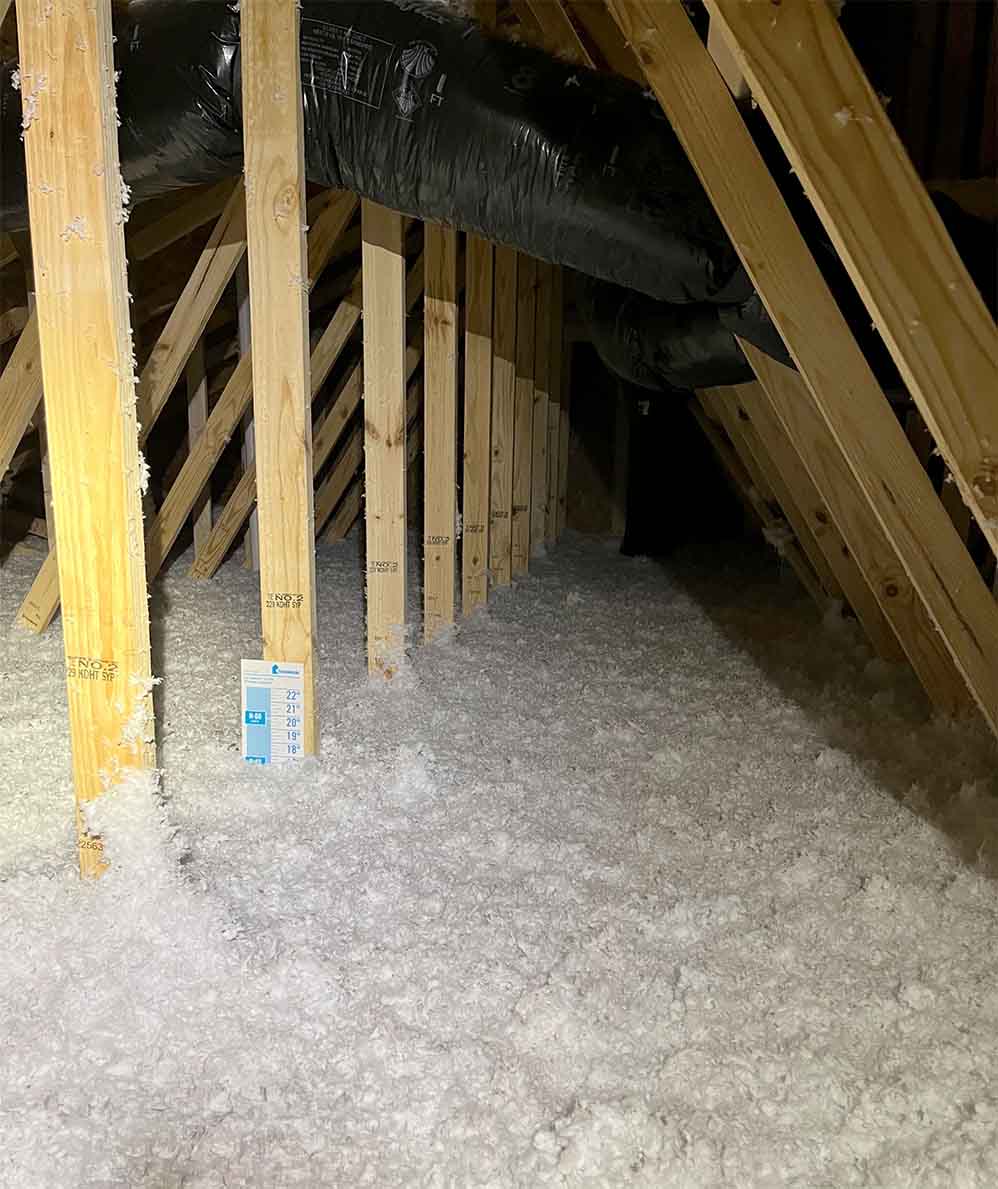
Begin by finding out what type of insulation you have and measuring its depth in a few spots. Here are some typical R-values per inch:
- Loose-fill fiberglass: R-2.2 per inch
- Fiberglass batts: R-3.2 per inch
- Cellulose: R-3.7 per inch
To reach R-49, you’ll need about 15 inches of fiberglass batts or about 13 inches of loose-fill cellulose.
Your blown-in insulation depth may vary across the attic if the material has settled or shifted. Measure in several places instead of just checking the deepest area.
The Wall Check
It’s harder to check wall insulation because it’s hidden. One easy way is to turn off the power, remove an outlet cover on an exterior wall, and look inside to see if there’s insulation.
This won’t tell you the exact wall insulation R-value, but it can show if the wall cavity is empty.
Seal Before You Insulate
Before you add insulation, check for air leaks. Gaps around pipes, wires, attic hatches, and wall tops can let air move around the insulation and make it less effective.
The order is important: seal first, then add insulation. Professional air sealing can find and close leaks that are hard to spot.
Age of Home
Homes built before Delaware’s current energy code are more likely to have less insulation than today’s standards. But age alone doesn’t mean a home needs more insulation. Past upgrades and installation quality also matter.
A professional evaluation can confirm whether the insulation and air sealing in a Delaware home meet the current recommendations.
What Getting It Right Pays Back
The Numbers
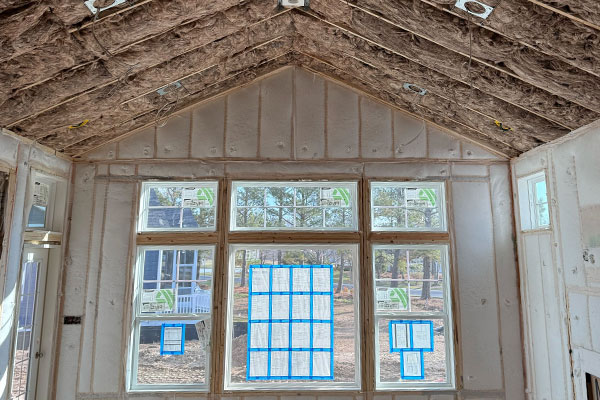
Heating and cooling make up almost half of a typical home’s yearly energy costs. Adding the right insulation can save homeowners an average of about 15% on electricity bills.
Beyond the Bills
Good insulation helps keep room temperatures steady and reduces the strain on your heating and cooling system.
To improve your home energy efficiency in Delaware, you need more than just extra insulation. It should be installed in the right areas, reach the right R-value, and be paired with good air sealing.
Cost Questions
The cost of your project depends on the size of the area, how easy it is to access, what insulation you already have, the materials you choose, and whether you need removal or air sealing. For more details, see how much insulation costs in Delaware.
Frequently Asked Questions
Get a Clear Answer for Your Home
There isn’t one insulation number for a whole Delaware home. Attics, walls, floors, basements, and crawl spaces each have their own targets based on Delaware’s Zone 4A climate and the 2018 IECC Delaware requirements.
Start with the attic and fix air leaks before adding more insulation. How much insulation you already have, the type of material, and how well it is installed all affect its performance.
Delmarva Insulation is based in Georgetown and serves homeowners in New Castle, Kent, and Sussex counties. To schedule a home insulation evaluation and see how your current levels compare to the recommended Zone 4A targets, call 302-854-0344 or contact us today.