Spray foam insulation has become one of the most popular ways to insulate Delaware homes and buildings. It’s the only insulation product that both insulates and air-seals in one step. This makes it a top choice for local builders and homeowners dealing with our state’s climate of hot, humid summers and cold, damp winters.
Proper insulation and moisture control are key to creating a healthy, efficient home. In this post, we’ll cover what spray foam is, the types of spray foam, its benefits, and why it’s such a smart solution for Delaware’s mixed-humid climate.
What Is Spray Foam Insulation?
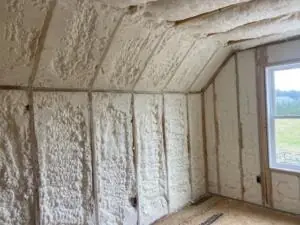
Spray foam insulation, also called spray polyurethane foam (SPF), is a spray applied, two-part liquid mixture made of specialized chemical components. When the foam is applied, the two materials mix and react to expand rapidly, creating foam that fills cracks, gaps, and voids in your building’s envelope.
As the foam expands, it forms a tight air barrier and high-performing thermal shield that stops air infiltration and reduces heat transfer. This is something traditional insulation materials, such as fiberglass and cellulose can’t do alone.
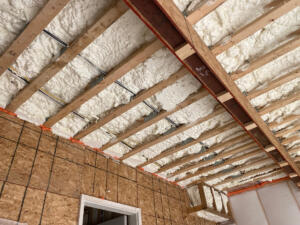
The foam hardens and adheres to wall studs, roof sheathing, and crawl spaces, eliminating the tiny gaps where outdoor air and moisture can sneak in. It can also conform to irregular shapes and hard to reach areas and be sprayed around piping, ductwork, and wiring.
For Delaware’s climate, this means fewer drafts, lower energy costs, and better year-round comfort.
Types of Spray Foam: Open-Cell vs. Closed-Cell
There are two main types of SPF: open-cell foam and closed-cell spray foam insulation. Both insulate and air seal, but they perform differently depending on where they’re used.
Open-Cell Spray Foam
Open-cell foam is lighter, softer, and has a spongy texture because its cells aren’t completely sealed. Tiny air pockets give it flexibility and excellent sound absorption qualities. It has an R-value of approximately R-3.8 per inch and is vapor-permeable. This means it lets water vapor pass through it.
Open-cell foam is ideal for interior walls, attics, and ceilings where moisture isn’t an issue. It’s great for sound control and air sealing, but because it can absorb water, it should not be used below grade or in damp areas. It’s also more budget-friendly than closed-cell foam but requires a thicker layer to reach the same R-value.
Closed-Cell Spray Foam
Closed-cell spray foam insulation is much denser, with tightly packed, closed bubbles. It is filled with gas that helps it expand and gives it a higher insulating power (approximately R-7.2 per inch). Once cured, it’s hard and rigid, adding structural strength to walls and rooflines.
It’s highly moisture resistant and acts as a vapor barrier, making it ideal for crawl spaces, exterior walls, and attics. Research from the University of Delaware found that closed-cell foam between roof rafters and sheathing can actually help strengthen your roof’s structure. This is a big plus in Delaware’s coastal areas that are prone to strong winds from storms or hurricanes.
Since closed-cell spray foam insulation doesn’t absorb water, it’s ideal for humid areas that may have minor flooding or prolonged dampness. Closed-cell foam is the preferred choice when maximum R-value, structural support or moisture protection is needed.
Choosing Between Types
Both types of spray foam stop air movement and seal effectively. Sometimes though it may not always be clear which spray foam is best for your project. In general:
- Homeowners often choose open-cell foam for interior comfort, noise control, and cost.
- Builders often prefer closed-cell foam to meet code-required R-values in confined or moisture-prone areas.
- Many Delaware homes and buildings use a combination of both types- open-cell for living areas and closed-cell in attics or crawl spaces.
Benefits of Spray Foam Insulation
Exceptional Energy Efficiency
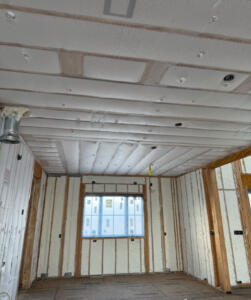
Spray foam’s high R-value and air-sealing ability dramatically improve your home or building’s energy efficiency. It’s estimated that as a homeowner, you can save an average of 15% on your heating and cooling costs by air sealing and insulating your home. In our variable climate, that’s a big deal that translates to less stress on your HVAC system and lower energy bills year-round.
Air Sealing and Comfort
SPF expands to every nook and cranny, stopping air infiltration better than traditional insulation. This helps your home maintain a steady indoor temperature and reduces drafts and cold spots. It also improves your indoor air quality by protecting against outdoor pollutants and allergens.
Delaware’s most current energy code limits a new home’s air leakage to three air changes per hour at 50 Pascals pressure (ACH50). Spray foam makes it easier to hit that target.
Moisture Control and Mold Prevention
Closed-cell spray foam insulation acts as a moisture barrier and protects against mold in our humid environment, especially during the summer. It works especially well on crawl space walls to seal out humid air and help prevent condensation. In fact, local homeowners are encouraged by Delaware’s Department of Natural Resources and Environmental Control (DNREC) to encapsulate their crawl space. The DNREC notes that sealing and encapsulating your crawl space protects your structure from moisture, reduces mold growth and improves indoor air quality and energy efficiency.
Enhanced Structural Strength
Closed-cell foam hardens into a tough layer that reinforces your walls and roof. When it is applied between your home’s wall studs or roof rafters, it seals the assembly together increasing racking strength. This added strength is especially valuable for coastal properties during high-wind events such as a nor’easter or hurricane.
Longevity and Low Maintenance
Once installed, spray foam doesn’t sag or settle. It adheres permanently to surfaces and stays put, continuing to insulate and seal for decades. It’s an “install it and forget it” solution that won’t need replacement.
Noise Reduction
Open-cell foam’s sound-dampening properties make it ideal for interior walls or homes near busy roads. Even closed-cell foam helps reduce some noise by sealing small gaps and adding mass to structures.
Spray Foam in Delaware Homes and Climate
Delaware is in a mixed-humid climate zone (Zone 4A), which means homes here need insulation that can handle both cold winters and humid summers.
Attics and Energy Codes
Delaware follows the 2018 IECC energy code. This code outlines the energy requirements for every newly constructed home or building in the state. The code requires at least R-49 of insulation in ceilings/attics and R-20 in above-grade walls for new construction. Spray foam provides an easy way to meet requirements with less thickness. Plus, since closed cell spray foam insulation delivers over R-7 per inch, it can meet those targeted R-values in tighter spaces.
Spray foam also helps builders meet our state’s blower-door test requirement of no more than 3 air changes per hour (ACH50). Unvented attics, where foam is applied to the roofline, are becoming more common and help bring the attic into the conditioned space for better HVAC efficiency and indoor air quality.
Crawl Space Encapsulation
Many Delaware homes have a crawl space due to high water tables. Traditional vented crawl spaces often lead to mold and moisture problems. Today, creating an unvented, encapsulated crawl space is the preferred solution. Closed-cell spray foam insulation is commonly used to seal crawl space foundation walls and sill plates. Foam’s moisture resistance is critical for minor flooding or ground moisture. It helps to create a dry, insulated crawl space that helps keep your first floor comfortable. Just 2 inches of closed-cell foam meets our state’s R-10 to R-13 recommendation. It’s important that the job be done by a professional to avoid further issues.
Coastal & Wind Considerations
Spray foam performs well in Delaware’s coastal areas. It resists moisture, holds up to salt air, and prevents air movement caused by coastal winds. The FEMA-approved status of closed-cell foam for flood-prone zones makes it a smart pick for shore homes.
Professional Installation and Safety Considerations
Spray foam should always be installed by trained professionals who can ensure proper mixing, temperature, and ventilation. During installation, the chemicals in spray foam release fumes. The pros wear protective gear and ventilate the area until the foam cures safely and all the fumes are released. After curing, spray foam is inert, and it is safe for your family and pets to return home.
Most modern spray foams now use low-GWP (Global Warming Potentials) blowing agents, replacing older high-impact HFCs (Hydrofluorocarbons). Delaware is one of twelve states to prohibit the use of HFCs in spray foam over the past few years.
To encourage energy upgrades in Delaware homes and make them more affordable, initiatives such as Energize Delaware and the Weatherization Assistance Program offer energy-saving programs, rebates and financing for energy upgrades.
Air Seal & Insulate with Spray Foam
Spray foam insulation offers a unique combination of high R-value and air sealing in one product. Built to handle our Mid-Atlantic climate, it keeps your home comfortable, durable, and efficient for decades.
Whether you’re a homeowner looking to improve comfort or a builder aiming for better code compliance and performance, Delmarva Insulation has the experience and local knowledge to get it done right. Our team will help you find the right spray foam for the attic, walls, and crawl space of your Delaware home or building.
Contact us today for a free estimate and discover why builders and homeowners across Delaware and beyond count on Delmarva Insulation for professional, dependable spray foam installation.
References
Delaware Department of Natural Resources and Environmental Control. (n.d.). Vapor barrier crawlspace encapsulation. https://documents.dnrec.delaware.gov/I-ADAPT/AdaptationStrategies/Vapor%20Barrier%20Crawlspace%20Encapsulation.pdf
Delaware Department of Natural Resources and Environmental Control. (n.d.). Weatherization Assistance Program. https://dnrec.delaware.gov/climate-coastal-energy/sustainable-communities/weatherization/
Delaware Department of Natural Resources and Environmental Control. (2021, March). 1151 prohibitions on use of certain hydrofluorocarbons in specific end-uses. Delaware.gov. https://regulations.delaware.gov/register/march2021/final/24%20DE%20Reg%20876%2003-01-21.htm
Delmarva Spray Foam. (n.d.). Open-cell vs. closed-cell spray foam. https://delmarvafoam.com/open-cell-vs-closed-cell/
Energize Delaware. (n.d.). Powering a cleaner and efficient Delaware. https://energizedelaware.org
Institute for the Building Envelope (IBE). (2024, January 12th). Closed-cell spray foam insulation is key to mitigating disaster in flood-prone areas. https://theibe.org/closed-cell-spray-foam-insulation-is-key-to-mitigating-disaster-in-flood-prone-areas/
Insulation Institute. (2020). Delaware energy code requirements. https://insulationinstitute.org/wp-content/uploads/2020/08/DE_Code-FINAL.pdf
U.S. Department of Energy. (n.d.). Insulation materials. Energy Saver. https://www.energy.gov/energysaver/insulation-materials
U.S. Department of Energy. (2009, April 3rd). Which spray foam is right for you? Energy.gov. https://www1.eere.energy.gov/buildings/publications/pdfs/building_america/spray_foam_guide.pdf
U.S. Department of Energy. (n.d.). Unvented crawl spaces code adoption. Energy Efficiency & Renewable Energy. https://www.energy.gov/eere/buildings/articles/unvented-crawlspace-code-adoption-building-america-top-innovation
U.S. Environmental Protection Agency. (n.d.). Crawlspace insulation technology fact sheet. ENERGY STAR. https://www.energystar.gov/sites/default/files/asset/document/Technology%20Fact%20Sheet%20Crawlspace%20Insulation.pdf
U.S. Environmental Protection Agency. (n.d.). Insulation fact sheet. ENERGY STAR. https://www.energystar.gov/sites/default/files/asset/document/Insulation%20Fact%20Sheet.pdf
U.S. Environmental Protection Agency. (n.d.). Seal and insulate with ENERGY STAR methodology. ENERGY STAR. https://www.energystar.gov/saveathome/seal_insulate/methodology
Weather Spark. (n.d.). Climate and average weather year-round in Georgtown, Delaware. https://weatherspark.com/y/22658/Average-Weather-in-Georgetown-Delaware-United-States-Year-Round