When electric rates go up, the first thing you notice is your bill. What’s less obvious is how much of that electricity goes to replacing heat your home loses.
This year, losing heat will cost you more. Delmarva Power customers on default supply saw the residential winter supply rate increase 20% on June 1, from $0.094804 to $0.114049 per kWh. If your attic is not well insulated, heat escapes during the heating season, so you use more electricity to keep your home comfortable.
Air sealing and adding insulation can lower heating and cooling costs by about 15% on average. In our example of an electrically heated Delaware home, that means saving roughly $15 to $20 on January supply charges alone.
The good news is you can estimate what this is costing you. With the current winter rate, your electric bill, and the average savings associated with air sealing and insulation, the four-step formula below shows how to estimate your monthly impact.
Delivery charges are additional, so the supply-side number is just a conservative starting point, not the full picture of your bill.
Find your last January bill and one from a mild month like April or October and follow along. These two numbers will help you see your potential attic insulation savings in Delaware. An attic evaluation can confirm if your insulation depth matches the example here.
The 2026 Rate Increase Changed the Math
What Delmarva Power Customers Are Paying Now
With the new Delmarva Power winter rates, wasted electricity now costs more than it did before the June 1, 2026 increase, when the residential Standard Offer Service winter supply rate rose 20%, from $0.094804 to $0.114049 per kWh. The residential space-heating rate also increased 17% from $0.085805 to $0.100515 per kWh.
For a typical customer using around 811 kWh a month, the estimated change added about $14.64 to the monthly bill. The impact is even bigger in high-usage months. This is not just a one-year increase. Delaware residential winter rates have risen 92.4% since 2021.
The Delmarva Power rate increase in 2026 is especially noticeable during the high-use winter months.
Why the Attic Is Where the Money Leaks
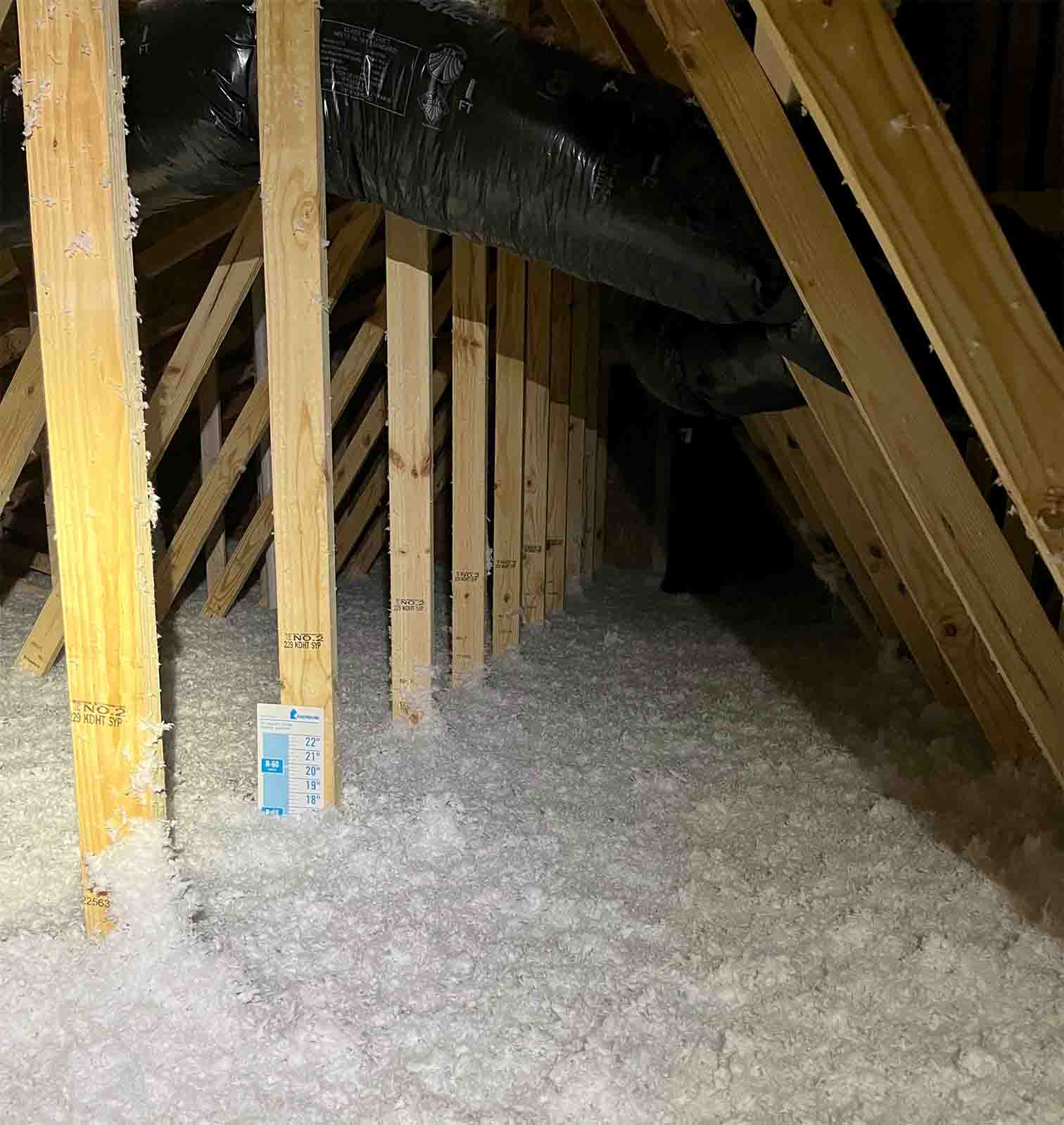
About 38% of Delaware households heat with electricity. In these homes, heat loss quickly adds extra kWh to the electric bill. Warm air rises, and the attic floor is the biggest single surface between your heated living space and the outdoors. If the attic is underinsulated, this large area can become the biggest source of conductive heat loss in the house.
For homes in Climate Zone 4A, it’s recommended to have R-60 in an uninsulated attic, or R-49 if you already have three to four inches of insulation. If you’re not sure where your attic stands, How Much Insulation Does Your Delaware Home Really Need? breaks down Zone 4A attic insulation R-value targets and what they mean for your home.
The Four-Step Formula
Step 1: Find Your Heating Load
Begin by looking at your electric bills. Check how many kWh were used in January, then compare it to a mild month like April or October. Since lighting, appliances, water heating, and other everyday electric loads usually stay about the same, the difference gives you a rough idea of how much electricity went to heating.
Here’s the illustrative home we’ll use. This is not an average:
- January: 1,800 kWh
- Mild month: 600 kWh
- Estimated January heating load: 1,200 kWh
That 1,200 kWh isn’t a Delaware average. It’s just an example to make the calculation easy to follow. Your bills are the best gauge.
Step 2: Price It at the Winter Rate
Now, take your estimated heating load and multiply it by the current winter supply rate: 1,200 kWh × $0.114049 = about $137
In this case, roughly $137 of January supply charges come from heating. This gives us a starting point for Delaware electric heat costs before considering any potential savings.
Step 3: Apply the ENERGY STAR Savings Average
This is where the attic makes a difference.Homeowners can save about 15% on heating and cooling costs, on average, by combining air sealing with added insulation in attics, floors above crawl spaces, and basement rim joists.
For our illustrative home: 15% of $137 = about $20.50.
Rounded down, that’s about $20 in January supply savings. The 15% savings isn’t just from attic insulation. It’s a national average that reflects air sealing and insulation together in several parts of the home. The published methodology explains how the estimate is calculated.
That’s why the calculation includes air sealing, not just insulation. Actual air sealing and attic insulation savings depend on your home’s condition before any work is done.
Step 4: Add Back the Delivery Side
Thus far, we’ve only looked at the electricity supply rate. Your bill also includes delivery charges per kWh, on top of supply. We’re not estimating those charges here, but it means your real monthly impact is higher than the supply-only number. The $20 example is a conservative estimate. For a home with an underinsulated attic, attic insulation is the upgrade this calculation is pricing.
The Same Math Across the Whole Heating Season
Heating Degree Days Show How the Load Moves Month to Month
January doesn’t show the whole picture. Heating needs change throughout the season as temperatures go up and down. That’s where heating degree days in Delaware help show how the load changes. Heating degree days, or HDD, measure how far the average daily temperature falls below 65°F. For example, if the average temperature for a day is 40°F, that day counts as 25 HDD.
For Wilmington, the 1991–2020 monthly normals are 266 HDD in October, 551 in November, 832 in December, 976 in January, 824 in February, and 676 in March. Wilmington is the published reference point used here. Kent and Sussex counties are usually a bit milder.
The Worked Example, Month by Month
Now, let’s use the January example to look at the whole heating season. For the same illustrative home, here are the approximate supply-side savings for each month:
- November: $12
- December: $17
- January: $20
- February: $17
- March: $14
That means from November through March, supply-side charges add up to roughly $80 to $90, before delivery charges. October and April add a few more dollars.
Again, this is just one illustrative home, and your bill will differ. Your own winter electric bill in Delaware is the best source.
What Moves the Number Up or Down
The savings may be higher if your home uses resistance electric heat, has little attic insulation, a large single-story footprint, or attic openings that haven’t been sealed.
Savings may be lower if your home has a newer heat pump, insulation close to R-38, a two-story layout with less attic area relative to the living space, or a milder winter than usual.
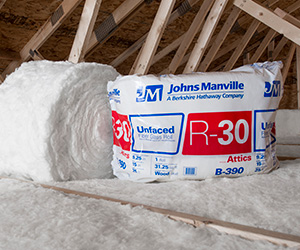
A heat pump winter bill in Delaware will look different from a resistance-heated home because heat pumps use less electricity to provide the same amount of heat. You can add blown-in fiberglass to bring insulation up to the Zone 4A target if your attic is below the recommended level.
To lower heating bills in Sussex County, start with your own usage instead of assuming a statewide example fits your home. Natural gas users can still benefit from reducing heat loss, but this calculation is based on electric heating costs and doesn’t apply to gas bills.
FAQ
With the 2026 winter rate increase, every extra kilowatt-hour used to replace lost heat now costs more. The four-step formula above helps you estimate that heat loss using your own bills.
For the example home, that’s roughly $15 to $20 in January supply charges, with savings at different levels through the rest of the heating season. Delivery charges are added on top of supply, so your total bill impact can be higher.
Try the formula with your own bills from last winter, then compare the result to your attic’s insulation depth. This gives you a starting point based on your home, not just the example.
Delmarva Insulation offers a free attic evaluation and estimate to check your current insulation depth and give you a real starting point.
References
Delaware Climate Office. “Current Climate Summary Maps for Delaware.” University of Delaware Center for Environmental Monitoring and Analysis, climate.udel.edu/data/current-climate-summary-maps/. Accessed 10 Sept. 2026.
Delaware Division of the Public Advocate. “Historical Review of Delmarva Power Electric Residential Rates.” State of Delaware, publicadvocate.delaware.gov/historical-review-of-delmarva-power-electric-residential-rates/. Accessed 10 Sept. 2026.
Delaware Division of the Public Advocate. “Upcoming Electricity Rate Increase Adds to Cost Increases for Delmarva Customers.” State of Delaware News, 6 Apr. 2026, news.delaware.gov/2026/04/06/upcoming-electricity-rate-increase-adds-to-cost-increases-for-delmarva-customers/. Accessed 10 Sept. 2026.
ENERGY STAR. “Methodology for Estimated Energy Savings.” U.S. Environmental Protection Agency, www.energystar.gov/saveathome/seal_insulate/methodology. Accessed 10 Sept. 2026.
ENERGY STAR. “Recommended Home Insulation R-Values.” U.S. Environmental Protection Agency, www.energystar.gov/saveathome/seal_insulate/identify-problems-you-want-fix/diy-checks-inspections/insulation-r-values. Accessed 10 Sept. 2026.
ENERGY STAR. “Why Seal and Insulate?” U.S. Environmental Protection Agency, www.energystar.gov/saveathome/seal_insulate/why-seal-and-insulate. Accessed 10 Sept. 2026.
U.S. Energy Information Administration. “Delaware State Energy Profile.” EIA, www.eia.gov/state/?sid=DE. Accessed 10 Sept. 2026.